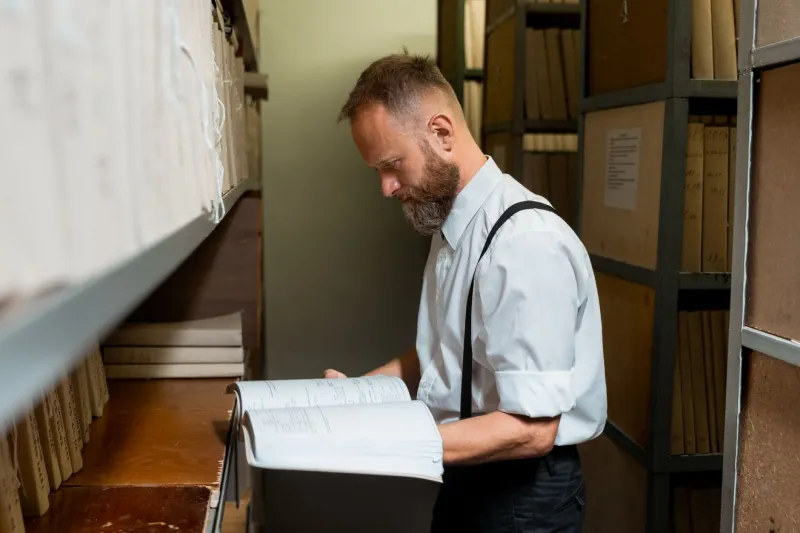
Buried in the Archive: How American Newsrooms Let Factual Errors Quietly Outlive the Stories That Contained Them
When a factual error generates immediate public outrage, most established American newsrooms respond with reasonable efficiency. The correction notice appears, the offending paragraph is revised, and editors move forward. The system, imperfect as it is, at least registers the problem. But what happens to the errors that no one notices right away? What becomes of a misattributed statistic in a 2017 feature, a misidentified official in a 2014 investigation, or a court outcome reported prematurely and never updated? In the age of the searchable digital archive, those errors do not simply fade from memory. They persist, indexed by search engines, cited by students and researchers, and encountered daily by readers who have no reason to suspect the information they are reading was wrong at the moment of publication and has remained wrong ever since.
This is the correction that never comes—not because newsrooms are indifferent to accuracy in principle, but because the institutional architecture required to systematically surface and address old errors rarely exists in American journalism.
The Architecture of Neglect
To understand why uncorrected archival errors are so common, it helps to understand how corrections are typically generated in the first place. At most U.S. outlets, the correction process is reactive rather than proactive. An editor, a reader, or the subject of a story raises a concern; the newsroom investigates; a correction is issued. The entire system depends on someone outside the original reporting chain noticing the problem and caring enough to report it.
That model functions reasonably well for high-profile, recently published content. It functions poorly for anything older, more obscure, or published before the current editorial staff arrived. A story from six years ago that contains an error in a supporting data point is unlikely to generate a complaint unless it resurfaces in a particularly visible context. And even when a complaint does arrive, the reporter who filed the original piece may have left the organization, the editor who approved it may have moved to a different desk, and the institutional memory required to adjudicate the dispute may simply no longer exist.
Several editors at mid-sized regional outlets, speaking on background for this article, acknowledged that their newsrooms have no formal mechanism for auditing older content. "We correct what gets flagged," one said. "We don't have the staff to go looking for problems we haven't heard about yet."
Digital Permanence and the Shifting Stakes
The problem has grown considerably more consequential in the digital era, for a reason that is easy to state and difficult to resolve: online archives do not decay. A print correction issued in 1998 reached a finite audience on a specific day and then largely disappeared from circulation. A digital correction issued—or not issued—in 2025 affects every future reader who encounters that article through a search engine query, a social media link, or a citation in another publication.
Researchers at several journalism schools have documented instances in which factually inaccurate news articles ranked highly in search results for years after the errors they contained had been quietly identified but not formally corrected. In some cases, the inaccurate version of a story had been shared thousands of times across social platforms, while the corrected version—when it eventually appeared—received a fraction of that distribution. The asymmetry between the reach of an error and the reach of its correction is one of the defining structural problems of contemporary digital journalism, and it is one that most newsrooms have not yet seriously confronted.
The Resource Constraint That Shapes Everything
Any honest accounting of this problem must acknowledge the resource realities that shape it. American newsrooms have contracted dramatically over the past two decades. The Pew Research Center has documented the sustained decline in newsroom employment across the country, and the editors who remain are, by virtually every measure, being asked to do more with less. In that environment, retrospective fact-checking of archived content is not a priority that can easily compete with the demands of daily publication.
"It's not that we don't care," a standards editor at a large metropolitan daily explained. "It's that there are only so many hours, and the archive represents tens of thousands of stories. Where do you even begin?"
That question is not rhetorical. Some organizations have begun experimenting with structured approaches to the problem. A small number of outlets have implemented what might be called "living story" frameworks, in which certain categories of coverage—criminal justice outcomes, legislative developments, ongoing investigations—are flagged for periodic review so that significant developments can be appended to the original record. Others have invested in reader-facing correction portals designed to lower the friction involved in submitting a dispute. These are meaningful steps, but they remain the exception rather than the rule.
When the Error Has a Subject
The stakes of this problem are not abstract. Behind every uncorrected error in a digital archive, there is frequently a real person whose reputation, livelihood, or safety may be affected by information that was wrong when it was published and has never been formally revised. Individuals who were incorrectly identified as suspects in criminal cases, businesses that were falsely associated with regulatory violations, public officials whose records were mischaracterized in the course of a competitive election—all of these subjects exist in an uncomfortable limbo in which the public record contains a version of events that the newsroom itself may privately acknowledge is inaccurate, yet has never formally corrected.
The legal dimension of this problem is evolving. Defamation law in the United States has historically placed a high burden on plaintiffs, particularly public figures. But legal scholars have noted that the persistence of uncorrected digital errors may, in some jurisdictions and contexts, affect how courts evaluate the question of actual malice—a development that newsrooms and their legal counsel are beginning to take more seriously.
Toward a More Honest Archive
The solution to this problem does not require unlimited resources. It requires, more fundamentally, a shift in how newsrooms conceptualize their obligations to the archive. A story does not cease to be the newsroom's responsibility the moment it is published. So long as it remains publicly accessible—and in the digital environment, that means indefinitely—the accuracy of that story remains a live editorial concern.
Practically, this means several things. It means building correction workflows that do not depend entirely on external complaints. It means investing in technology that can flag articles for review when significant new information emerges on a topic they cover. It means establishing clear editorial policies about when and how older articles are updated, and communicating those policies transparently to readers. And it means treating the correction of an old error not as an admission of institutional failure, but as an act of journalistic integrity—precisely the kind of integrity that distinguishes serious news organizations from the noise that surrounds them.
The archive is not a graveyard. For millions of Americans, it is a living reference point, consulted daily in the course of making sense of a complicated world. The newsrooms that built that archive have a responsibility to ensure it reflects the best available truth—not merely the truth as it was understood at the moment of publication, but the truth as it is understood now. That responsibility does not expire. Neither, unfortunately, do the errors.